
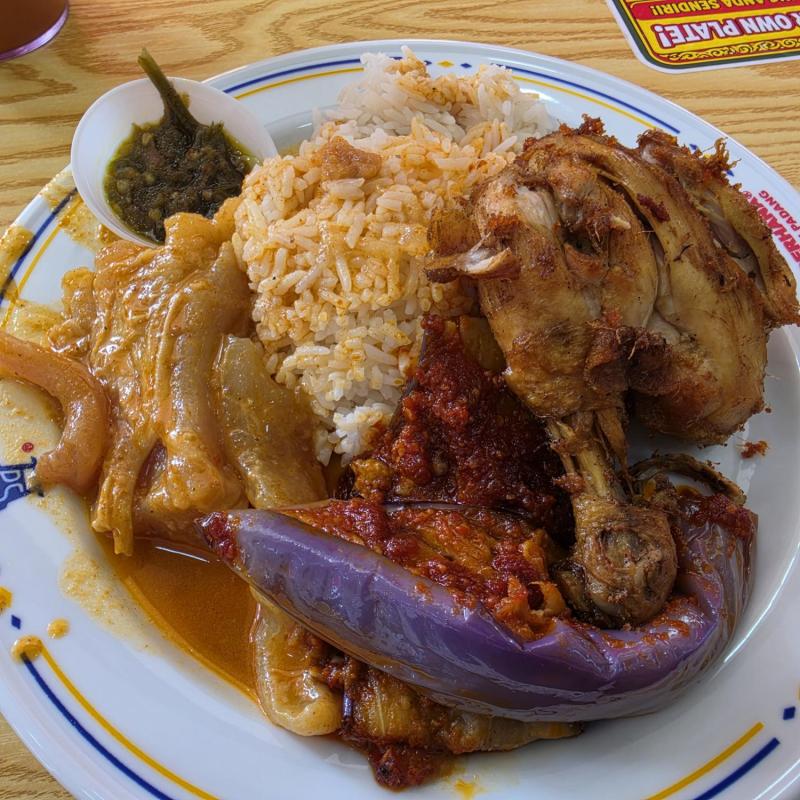
Stand in front of a nasi padang counter at lunchtime and the choice can feel overwhelming. Trays of beef rendang, dark and glossy from hours in the pot. Chicken bathed in turmeric-yellow gulai. Jackfruit stewed soft in coconut milk, bright green chilli relish, crisp fried lung, sambal goreng studded with tempeh. Behind it all, a server with a ladle, waiting for you to point.
Nasi padang is one of the most satisfying meals in Singapore, and one of the most personal: no two plates are the same. This guide explains what it is, where it comes from, what the dishes are called and how to order without hesitating, then points you to halal places across the island to try it.
What Is Nasi Padang?
Nasi padang is steamed white rice served with a choice of pre-cooked dishes from the cuisine of the Minangkabau people of West Sumatra, Indonesia. It is named after Padang, the capital of West Sumatra. A typical plate combines a meat such as beef rendang, a curry or gulai, a vegetable and sambal, finished with a ladle of gravy over the rice.
In Singapore you order by pointing at the dishes you want from a glass-fronted display, and you pay for what you choose. That flexibility is the appeal: a light plate of rice, vegetables and egg, or a feast with three kinds of meat, from the same counter.
Where Nasi Padang Comes From
The Minangkabau, often shortened to Minang, live mainly in the highlands and coast of West Sumatra. Their cooking is known for rich coconut milk, fresh chilli, turmeric, lemongrass, galangal, tamarind and long, patient cooking.
Minang culture has a strong tradition of merantau, young people leaving home to seek their fortune elsewhere, and Padang restaurants travelled with them. Today they are found across Indonesia and in Malaysia, Singapore and Brunei. In Indonesia they are easy to spot: many have facades shaped like the Rumah Gadang, the Minang house with its sweeping, horn-like roof, and front windows stacked with plates of food.
Rendang sits at the heart of this cuisine. A popular legend says it was perfected as travelling food, because meat cooked down until almost dry keeps far longer than a wet curry. Whatever its precise origin, it has become a symbol of Minang identity, and Indonesia has recognised several regional rendang preparations as intangible cultural heritage.
How Nasi Padang Came to Singapore
Singapore’s nasi padang story is centred on Kampong Glam, the historic Malay-Muslim quarter around Sultan Mosque. In 1948, a man named Isrin opened Warong Nasi Pariaman at the corner of North Bridge Road and Kandahar Street. Pariaman is a coastal town in West Sumatra, and the family-run stall became, according to the National Library Board, the oldest surviving nasi padang stall in Singapore. Regulars came in droves after Friday prayers at the nearby mosque, and many families ate there for two or three generations.
Warong Nasi Pariaman closed on 31 January 2026 after 78 years, with long queues outside on its final days. In May 2026, Sederhana, a nasi padang chain from Indonesia founded in 1972, opened its first Singapore outlet in the same shophouse at 738 North Bridge Road. One of the most famous names in Padang food now cooks on one of Singapore’s most storied nasi padang corners.
Kampong Glam’s other long-running names include Rumah Makan Minang on Kandahar Street, whose family roots in the trade go back to 1954, and Hjh Maimunah on Jalan Pisang, founded in 1992 and later recognised for several years in the Michelin Guide’s Bib Gourmand selection.
Over the decades, nasi padang has blended into Singapore’s wider Malay food culture. Many neighbourhood stalls serve Minang classics alongside Malay and Javanese favourites such as sambal goreng, tahu telur and begedil, so the line between nasi padang and nasi campur (mixed rice) is often blurred.
The Dishes: A Field Guide to the Counter
Every stall has its own line-up, but these are the dishes you are most likely to see.
| Dish | What it is | What to expect |
| Rendang daging | Beef simmered in coconut milk and spice paste until the liquid is almost gone | Dark, tender and intensely spiced, with caramelised edges |
| Kalio | A wetter, lighter-coloured cousin of rendang, taken off the heat earlier | Saucier and milder |
| Gulai ayam or gulai ikan | Chicken or fish in a turmeric and coconut milk curry | Rich and mellow, good for spooning over rice |
| Ayam pop | Minang chicken that is boiled or steamed, then briefly fried | Pale, delicate and usually eaten with chilli |
| Ayam bakar | Spiced chicken grilled over a fire | Smoky and slightly sweet |
| Dendeng balado | Thin slices of crisp beef tossed in chilli | Crunchy, sweet and spicy |
| Paru goreng | Fried beef lung | Crisp and savoury |
| Sayur nangka (gulai cubadak) | Young jackfruit stewed in coconut milk | Soft, creamy, almost meaty |
| Daun ubi or pucuk ubi | Cassava leaves, boiled or cooked in coconut milk | Earthy and soothing, a counterweight to the rich meats |
| Terung balado | Aubergine cooked in red chilli | Silky and spicy |
| Sambal goreng | Fried tempeh, tofu and long beans in a sweet chilli sauce, a Singapore staple | Sweet, spicy and textured |
| Begedil | A fried potato patty | Soft and comforting |
| Kikil | Beef skin braised until gelatinous | Chewy, rich and soaked in gravy |
| Sambal hijau (lado ijo) | Coarse relish of green chilli | Bright, sharp heat |
How to Order Nasi Padang in Singapore
Ordering is quick once you know the rhythm.
- Say whether you are eating in or taking away. “Makan sini” means eating here; “bungkus” means takeaway.
- Get your rice. Ask for less or more if you like. Some stalls also offer rice cooked with spices or coconut.
- Point at your dishes. Two or three is a typical plate: one meat, one vegetable and something with sambal.
- Ask for gravy. The server will ladle kuah, a mix of curry gravies, over your rice. Ask for “banjir” (flooded) if you love it soaked, or less if you prefer.
- Pay at the end. Each item is priced separately, so the total depends on what you picked. Premium items such as rendang usually cost more than vegetables.
In larger Padang restaurants in Indonesia you may meet a different style called hidang, where waiters bring a dozen small plates to your table and you pay only for what you eat. Singapore stalls almost always use the point-and-choose style, known in Indonesia as pesan.
Eating with your right hand is traditional and perfectly acceptable, and cutlery is always available. Go before the lunch rush for the full spread: most stalls cook through the morning, and popular dishes can sell out by early afternoon.
What Makes Great Nasi Padang
A great plate starts with the rendang. The meat should be tender enough to pull apart with a spoon, and the spice paste cooked down until it clings to the beef rather than pooling around it.
Look for sambal made in-house, with fresh chilli flavour rather than flat heat. Vegetables should still taste of themselves, not of hours under a warming lamp. Good stalls also balance their counter: something rich, something sharp, something green.
Finally, watch the queue. A busy stall turns its trays over quickly, which means fresher food and a wider choice.
Where to Find Halal Nasi Padang in Singapore
Every place below is listed on Halal Tag. Tap through for outlets, photos and community recommendations, and check the listing before you go, as stalls sometimes move or close.
Kampong Glam
- Rumah Makan Minang, Kandahar Street, with further outlets in Jurong West and at Our Tampines Hub. A long-established Minang name in the heart of the district.
- Hjh Maimunah, Jalan Pisang, with branches including Joo Chiat. Kampung-style Malay and Indonesian dishes; regulars recommend the tahu telur and nasi sambal goreng.
- Sabar Menanti, North Bridge Road. Another Kampong Glam stop for a nasi padang lunch, a short walk from Sultan Mosque.
- Sederhana Singapore, 738 North Bridge Road. The Indonesian chain’s first Singapore outlet, in the former Warong Nasi Pariaman shophouse. Look for rendang, ayam pop and cassava leaves in coconut milk.
Geylang Serai
- Hajjah Mona Nasi Padang, Geylang Serai Market and Food Centre. A popular hawker stall in the east’s main Malay food hub, also known for nasi ambeng.
Orchard and the city centre
- Minang House, Lucky Plaza. Convenient for shoppers on Orchard Road.
- Putra Minang, Bencoolen Street.
Neighbourhood favourites
- Che Rose Nasi Padang, Toa Payoh Lorong 1. Founded by Madam Rosmah, with home-style recipes and a beef rendang that draws regulars.
- Istana Minangkabau Nasi Padang, Ubi. A Minang stall in the Ubi industrial area, handy for a weekday lunch in the east.
- Rendang Nation, One Punggol Hawker Centre. As the name suggests, the focus is rendang, served as nasi rendang.
This is a starting point, not a ranking. Halal Tag’s Nasi Padang page lists more than 60 places, ranked by community recommendations, and you can find nasi padang near you. Rendang fans can go straight to the rendang listings.
A Visitor’s Guide: Words Worth Knowing
Nasi padang is one of the easiest ways for visitors to taste Malay and Indonesian cooking in a single meal, and it is filling and good value. Kampong Glam, a short walk from Bugis MRT station, is the most atmospheric place to start: combine lunch with a visit to Sultan Mosque and the shophouses of Arab Street. Most stall holders speak English, but these words help.
| Word | Meaning |
| Nasi | Cooked rice |
| Lauk | The dishes that go with the rice |
| Kuah | Gravy or curry sauce |
| Banjir | “Flooded”: lots of gravy on your rice |
| Daging / ayam / ikan / sotong | Beef / chicken / fish / squid |
| Sayur | Vegetables |
| Pedas / tak pedas | Spicy / not spicy |
| Makan sini / bungkus | Eat here / takeaway |
If you are new to chilli, ask which dishes are “tak pedas”. Ayam pop, gulai and the coconut vegetable dishes are usually milder than anything marked balado.
Nasi Padang and Nutrition
Because every plate is different, there is no single calorie count. As a rough estimate, Indonesian nutritionists put a typical plate of rice with rendang and coconut-milk vegetables at around 550 to 770 kcal. The rice alone accounts for much of that: 200g of steamed white rice is roughly 360 kcal.
Coconut milk, frying and repeated reheating push up the fat and salt, so a few easy choices make a lighter plate:
- Fill half the plate with vegetables, such as cassava leaves or long beans
- Choose grilled items like ayam bakar over fried ones
- Ask for less rice and less gravy
- Share a few meat dishes across the table rather than piling them onto one plate
These figures are estimates for general guidance only. If you have specific dietary needs, check with a healthcare professional.
Nasi Padang Facts Worth Knowing
- A world favourite. In 2011, an online reader poll of about 35,000 people by CNN International voted beef rendang the world’s most delicious food, and it topped CNN Travel’s reader poll again in 2017.
- Not just beef. In West Sumatra, rendang is also made with chicken, duck, shellfish and even young fern shoots.
- A Singapore recipe with a difference. Warong Nasi Pariaman’s rendang was known for leaving out the coriander and cumin that many other versions use.
- Lunch economics. When nasi padang prices rose around Jakarta in 2016, civil servants asked for their meal allowance to be raised to match.
- It has its own song. In 2016, a Norwegian man, Audun Kvitland Røstad, went viral in Indonesia with a love song to nasi padang.
Frequently Asked Questions
Is nasi padang halal?
The Minangkabau are predominantly Muslim and Padang cooking is traditionally halal. In Singapore, the simplest way to be sure is to choose a place listed on Halal Tag, which features only halal-certified and Muslim-owned establishments. Read more about why Muslim-owned establishments may not need halal certification.
Is nasi padang Malay or Indonesian?
It is Indonesian in origin, from the Minangkabau of West Sumatra, but it has been part of Singapore’s Malay food scene since at least the 1940s and many stalls mix Minang and Malay dishes.
What is the difference between nasi padang and nasi campur?
Nasi padang refers specifically to Minangkabau dishes such as rendang, gulai and balado. Nasi campur simply means mixed rice with assorted dishes from any tradition. In Singapore, many stalls serve a mix of both.
What should I order the first time?
Beef rendang, a vegetable such as sayur nangka or cassava leaves, a spoon of sambal goreng and a generous ladle of gravy. It covers the key flavours in one plate.
Is nasi padang very spicy?
It can be, but not every dish is. Balado and sambal dishes carry the heat; gulai, ayam pop and coconut-milk vegetables are gentler. Ask the server for “tak pedas” options.
What is the difference between rendang and kalio?
Kalio is rendang taken off the heat earlier, so it is wetter and lighter in colour. Rendang is cooked until the sauce has almost disappeared into the meat.
What was the oldest nasi padang stall in Singapore?
Warong Nasi Pariaman in Kampong Glam, founded in 1948, was regarded by the National Library Board as the oldest surviving nasi padang stall. It closed in January 2026, and Sederhana now operates at the same address.
Why is it called nasi padang?
Nasi means rice, and Padang is the capital of West Sumatra, the home of Minangkabau cooking.
Find Your Next Plate
Nasi padang rewards curiosity. Each counter is a little different, each plate is yours to build, and the best way to learn is simply to point, taste and go back for something new.
Start with the full list of nasi padang places on Halal Tag, or explore more Indonesian food and our guide to nasi lemak. Found a stall with a rendang worth crossing the island for? Recommend it so the next hungry reader can find it too.